You don’t think about your light bulb base — until the day a bulb burns out and the replacement doesn’t fit.
Suddenly, something as simple as buying a bulb feels technical. You see terms like E26 base, medium base, and standard light bulb base, and you’re left wondering if they all mean the same thing. If you’ve ever stood in a store aisle comparing packages or scrolled online unsure what to choose, you’re not alone.
Understanding the E26 bulb base gives you control. It helps you choose the right bulb the first time, avoid compatibility issues, and upgrade your lighting confidently. Once you understand how light bulb base sizes work, everything becomes easier.
Let’s break it down clearly.
E26 Bulb Base: Definition and Basic Overview
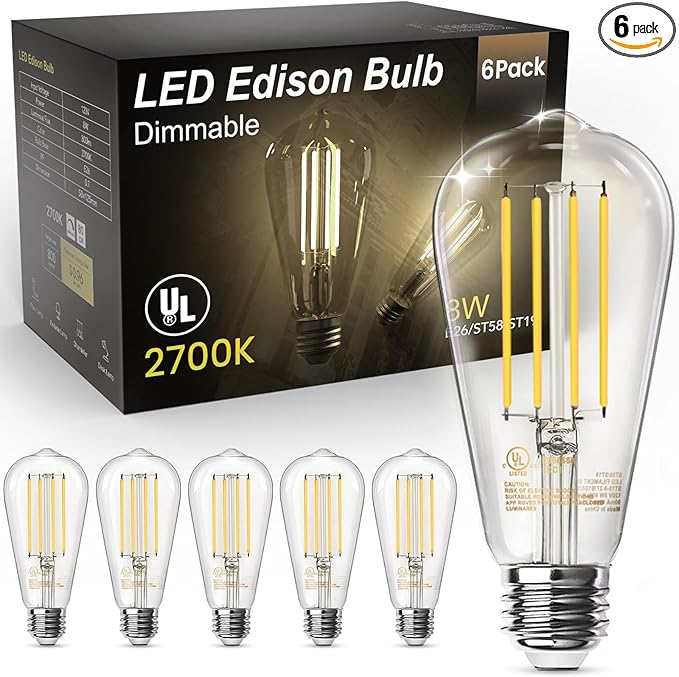
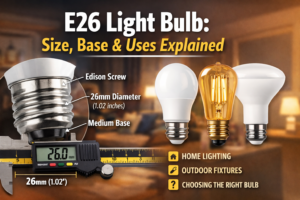
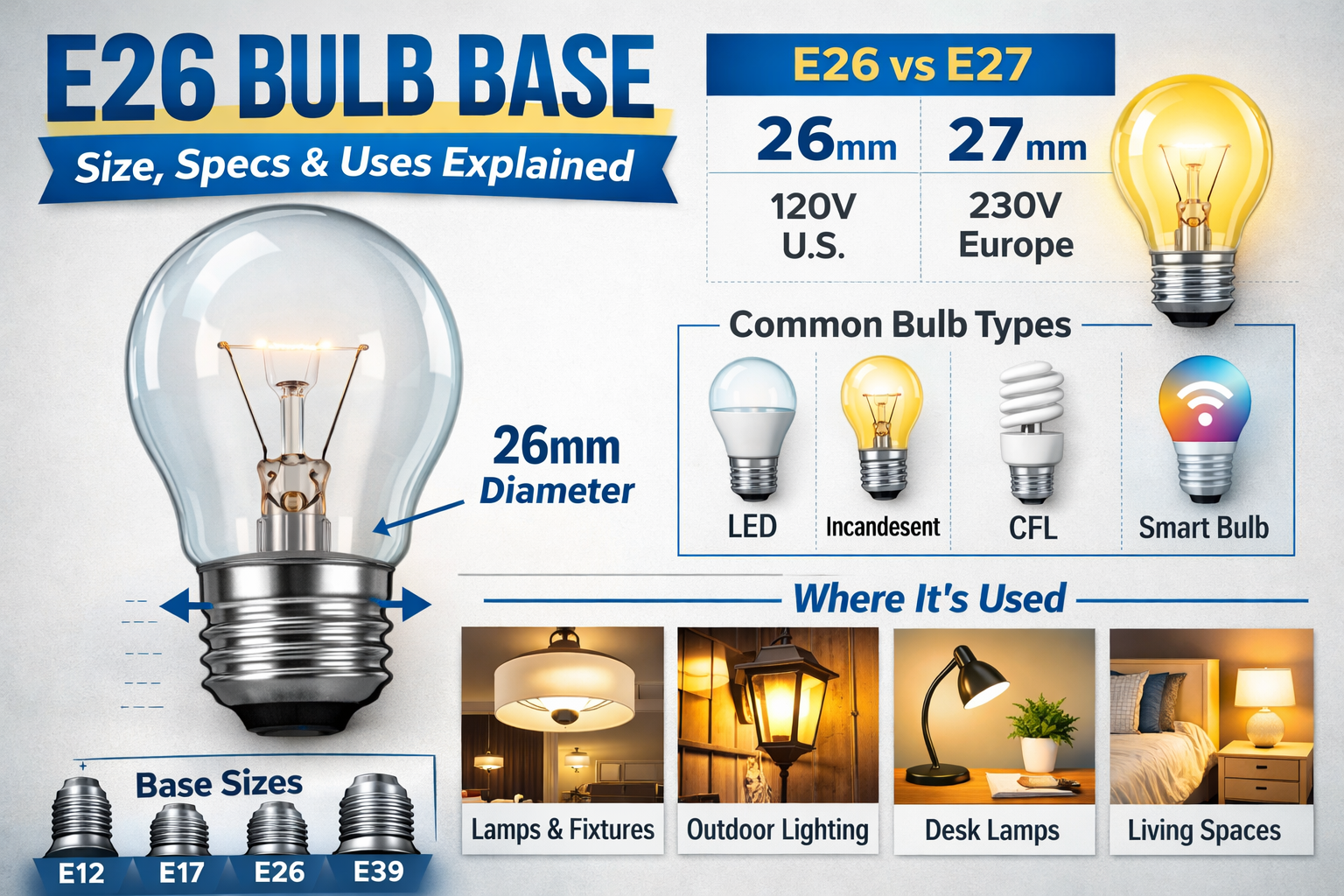
An E26 base is the most common screw-type light bulb base used in North America. It’s often referred to as the standard light bulb base because it fits most household fixtures.
The name explains its design:
- E = Edison screw (named after Thomas Edison)
- 26 = 26 millimeters in diameter
That means the threaded metal bottom of the bulb measures 26mm across.
When you screw in a lamp bulb, ceiling bulb, or porch light in the United States, you’re almost certainly using an E26 base.
Why the E26 Is the Standard Light Bulb Base in North America
If your home uses a 120-volt electrical system (which most North American homes do), the E26 base is designed for that voltage. Because of this compatibility, manufacturers label it as:
- Medium base
- Standard base
- E26 base
They all refer to the same thing in most U.S. applications.
When shopping for light bulbs E26, you’re simply choosing bulbs that fit this common screw size.
Light Bulb Base Sizes Explained (E12, E17, E26 & More)
To feel confident buying bulbs, you need a basic understanding of light bulb base sizes.
Light bulbs come in different base types depending on:
- Voltage system
- Fixture design
- Country standards
- Application (residential, commercial, industrial)
The Edison screw system includes several sizes:
- E12 – Candelabra base (small decorative bulbs)
- E17 – Intermediate base
- E26 – Standard light bulb base (U.S.)
- E27 – European standard base
- E39/E40 – Mogul base (large commercial fixtures)
Among all these, the E26 base dominates residential lighting in North America.
E26 Base Size: Exact Dimensions and Technical Details
The E26 bulb base has precise measurements that ensure a secure electrical connection.
Exact Specifications
- Diameter: 26 millimeters
- Threaded metal shell
- Designed for 120V systems
- Medium base classification
The threaded design ensures both mechanical stability and electrical contact when you twist the bulb into place.
Because it’s standardized, you don’t have to measure it manually. If your fixture uses a standard light bulb base, it’s almost always E26.
E26 vs E27: Key Differences You Should Know
You might see E27 bulbs online and wonder whether they’re interchangeable.
Here’s a clear comparison:
| Feature | E26 Base | E27 Base |
|---|---|---|
| Diameter | 26mm | 27mm |
| Voltage | 120V | 220–240V |
| Primary Region | North America | Europe |
| Fit Compatibility | Often fits | Often fits |
Physically, they are extremely similar. However, voltage ratings matter. If your home runs on 120V, you should choose light bulbs E26 specifically rated for your system.
Even a 1mm difference in diameter can affect tightness in certain fixtures.
How the E26 Base Compares to Other Incandescent Bulb Base Sizes
Before LED technology became dominant, most homes relied on incandescent bulbs. If you’ve ever looked into incandescent bulb base sizes, you’ll notice that many traditional incandescent bulbs used the E26 base.
That’s why the E26 base became known as the standard light bulb base.
Common incandescent base sizes include:
- E12 (small decorative bulbs)
- E26 (standard household bulbs)
- E39 (large industrial bulbs)
When LED bulbs replaced incandescent ones, manufacturers kept the same base sizes. That means you can upgrade to LED without changing your fixture.
What Types of Light Bulbs Use an E26 Base?
The E26 base works across multiple lighting technologies.
1. LED Bulbs
- Energy efficient
- Long lifespan (15,000–25,000 hours)
- Low heat output
2. Incandescent Bulbs
- Traditional warm glow
- Shorter lifespan
- Higher energy consumption
3. CFL Bulbs
- More efficient than incandescent
- Less common today
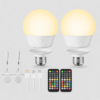
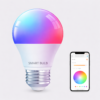
4. Smart Bulbs
- Wi-Fi or Bluetooth control
- App-controlled brightness
- Voice assistant compatibility
When shopping for light bulbs E26, focus on the lighting technology that suits your needs rather than worrying about base compatibility.
Common Bulb Shapes Compatible with the E26 Base
The base size stays the same, but bulb shapes vary depending on usage.
Here are common shapes compatible with the E26 base:
- A19 – Standard household bulb
- BR30 – Recessed lighting
- PAR38 – Outdoor floodlight
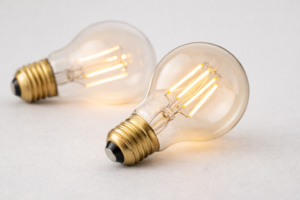
- ST64 – Vintage Edison style
- G25 – Globe-style vanity lighting
The shape affects light direction and aesthetics. The base ensures compatibility.
Where Is the E26 Bulb Base Commonly Used?
Once you recognize it, you’ll see the E26 base almost everywhere in your home.
Indoor Applications
- Ceiling fixtures
- Table lamps
- Floor lamps
- Kitchen pendants
- Bathroom mirrors
- Bedroom nightstands
Outdoor Applications
- Porch lighting
- Garage fixtures
- Security floodlights
- Entryway lighting
Because it’s the standard light bulb base, you rarely need adapters in a typical home.
How to Choose the Right E26 Bulb for Your Fixture
Choosing correctly involves more than matching the base.
Step 1: Confirm the Base Type
Check your fixture label. If it says “medium base” or E26, you’re safe.
Step 2: Check Maximum Wattage
Never exceed the fixture’s rated wattage.
Step 3: Choose the Right Brightness
Brightness is measured in lumens.
| Room | Lumens Needed | Color Temperature |
|---|---|---|
| Living Room | 800–1600 | 2700K–3000K |
| Kitchen | 1600–3000 | 3000K–4000K |
| Bathroom | 1100–2000 | 3000K–4000K |
| Office | 3000+ | 4000K–5000K |
Step 4: Select Color Temperature
- 2700K – Warm and cozy
- 3000K – Soft white
- 4000K – Bright neutral
- 5000K – Daylight
Step 5: Decide on Smart Features
If you want remote control or automation, choose smart light bulbs E26 compatible with your home system.
Benefits of Using an E26 Base
You benefit from several practical advantages when using an E26 base.
Wide Availability
Because it’s the standard light bulb base, you can find replacements almost anywhere.
Easy Installation
No special tools required — just screw it in.
Energy Upgrade Friendly
Switch from incandescent to LED without replacing the fixture.
Cost Efficiency
LED E26 bulbs significantly reduce electricity consumption compared to older incandescent bulb base sizes.
Common E26 Bulb Base Problems and How to Fix Them
Even reliable systems have occasional issues.
Bulb Won’t Turn On
Check for:
- Loose connection
- Power supply issue
- Burned-out bulb
- Faulty socket
Flickering
Possible causes:
- Loose bulb
- Incompatible dimmer switch
- Poor-quality LED driver
Overheating
If a bulb overheats:
- Ensure wattage isn’t too high
- Improve ventilation
- Switch to LED
Always turn off power before inspecting fixtures.
E26 Bulb Base FAQs (Quick Answers to Common Questions)
Is the E26 base the same as the standard light bulb base?
Yes. In North America, the E26 base is considered the standard light bulb base for residential fixtures.
Are light bulbs E26 interchangeable with other light bulb base sizes?
No. Light bulb base sizes vary. An E26 base will not fit E12 or E17 sockets.
Do incandescent bulb base sizes include E26?
Yes. Many traditional incandescent bulbs used the E26 base, making it widely adopted.
Can you use LED light bulbs E26 in older fixtures?
Yes. Many traditional incandescent bulbs used the E26 base, making it widely adopted.
How do you know if you need an E26 base?
Remove your old bulb and check the label. If it says “medium base,” you need an E26 base.
Why Understanding Light Bulb Base Sizes Matters
When you understand light bulb base sizes, you eliminate guesswork.
You:
- Avoid buying the wrong bulb
- Improve safety
- Reduce energy costs
- Upgrade lighting easily
- Make smarter purchasing decisions
A small detail like the E26 base affects compatibility, safety, and efficiency.
Conclusion: Choose the Right E26 Base with Confidence
Now you understand exactly what the E26 bulb base is, how it compares to other light bulb base sizes, and why it’s known as the standard light bulb base in North America.
You know:
- It measures 26mm in diameter
- It supports 120V systems
- It works with LED, incandescent, and smart bulbs
- It fits most residential fixtures
The next time you shop for light bulbs E26, you won’t hesitate. You’ll choose the correct brightness, color temperature, and technology with confidence.
If you’re upgrading your lighting, start by checking your current fixtures today. Replace outdated incandescent bulbs with energy-efficient LED E26 options and improve both comfort and savings in your home.
Better lighting begins with understanding the base — and now you’re equipped to make the right choice.
e26 bulb base,e26 bulb base,e26 bulb base,e26 bulb base,e26 bulb base,e26 bulb base,e26 bulb base,e26 bulb base,e26 bulb base,e26 bulb base,e26 bulb base,e26 bulb base,e26 bulb base,e26 bulb base,e26 bulb base,e26 bulb base,e26 bulb base,e26 bulb base,e26 bulb base,e26 bulb base.